
A patient’s guide to understanding rotator cuff tears, arthroscopic repair, and the honest timeline for getting better.
If you’ve been told you have a torn rotator cuff, you’ve probably already discovered that shoulder pain has a way of disrupting the small things — reaching for a seatbelt, sleeping on your side, lifting a kettle. This guide walks through what the rotator cuff actually is, the two very different ways rotator cuff tears develop, how we diagnose and repair them, and — just as importantly — what the recovery journey genuinely looks like over the following year.
What Is the Rotator Cuff?
Deep inside the shoulder, four tendons work together to hold the ball of the upper arm bone (the humeral head) securely in its shallow socket. These are the supraspinatus, infraspinatus, subscapularis, and teres minor — collectively known as the rotator cuff. A tendon is a tough, relatively bloodless band of tissue that anchors muscle to bone, and it’s this cuff of tendons that lets you lift your arm overhead, rotate it, and reach behind your back.
Two Different Roads to Rotator Cuff Tears
One of the things patients find most reassuring to understand is that rotator cuff tears essentially arrive by two quite separate routes — and it helps to know which one applies to you, because it shapes what to expect.
The first, and by far the most common, is simply the passage of time. Like every other tissue in the body, tendons lose some of their blood supply and elasticity as we age, and the fibres gradually thin and fray. It’s the same underlying process that leaves ageing skin thinner and less elastic, or hair greyer and finer — a quiet, genetically driven change in the tissue itself, rather than the result of anything done to it. This process usually begins quietly in the late 40s and 50s, often without any single moment you can point to — people are frequently surprised to learn a tear has been developing for years before it became painful. This is an intrinsic, biological process happening inside the tendon itself, not a mechanical injury from use — this gradual, age-related process is often discussed more broadly as rotator cuff disease.
The second route is trauma — a fall onto an outstretched arm, a sudden wrenching movement, or a heavy, unexpected load through the shoulder. In these cases, an otherwise reasonably healthy tendon tears acutely, and the onset of pain and weakness is usually sudden and clearly remembered.
A common misconception
It’s a widespread belief that years of physically demanding work or manual labour simply “wears out” the rotator cuff the way it wears out a pair of boots. The evidence doesn’t really support this as a primary cause. Degeneration is driven mostly by age-related changes within the tendon itself, and tears are driven by discrete trauma — not by cumulative hard work in isolation. Plenty of people with physically light lives develop degenerative tears, and plenty of lifelong labourers never do.
Often what brings the two together is that an aging, already-thinned tendon is more vulnerable to tearing completely with a relatively minor injury that a younger, healthier tendon would have shrugged off. So the story is frequently: quiet age-related weakening, followed by a fall or wrench that finishes the job.
Rotator cuff tears are also far more common than most people realise, and many sit quietly with no symptoms at all. Age remains the strongest risk factor, with most degenerative tears appearing after 40, and the dominant arm is affected more often than the other. If one shoulder has a degenerative tear, the opposite shoulder carries a meaningfully higher chance of developing one too, even before it becomes painful. Repetitive overhead activity — throwing and racquet sports, swimming, or trades like painting and carpentry — is recognised as a genuine contributing risk factor for degenerative tears, which is a more specific and limited claim than the broader idea that manual work in general simply wears the tendon out.
Why Rotator Cuff Tears Hurt
The pain of a rotator cuff tear rarely comes from just one source, which is part of why it can feel so persistent and hard to pin down. Most people notice pain deep in the shoulder and upper arm, often worse at night and disruptive to sleep, and worse again when reaching — for a seatbelt, a top shelf, or behind the back.
The rotator cuff normally forms a strong, protective layer over the top of the humeral head. When the tendon tears, this protective cushion is lost. The shoulder no longer moves smoothly, and the exposed area is subjected to abnormal forces. This increases irritation of the surrounding tissues, particularly the inflamed bursa and joint lining, leading to pain. If the tear remains untreated for many years, the humeral head may gradually migrate upwards, resulting in arthritis of the shoulder, which can become an additional source of pain.
Several things are usually contributing at once:
- The tear itself — torn tendon fibres are a direct source of pain and weakness.
- Impingement — the bone at the top of the shoulder (the acromion) and a nearby ligament (the coracoacromial ligament) can pinch the injured tendon as the arm moves.
- The AC joint — the small joint where the collar bone meets the shoulder blade (the acromioclavicular, or AC, joint) is extremely commonly arthritic on MRI in anyone over 50, and this is often a genuine contributor to pain, separate from the cuff tear itself.
- Sensitised nerves — with longstanding pain, the nerves supplying the shoulder can become abnormally sensitive, firing pain signals in response to only a small stimulus. This is a real, physical change in how the nerves behave, and it’s one reason recovery — even after a technically successful repair — can take considerably longer than people expect, since these nerves need time to settle back down.
True arthritis of the shoulder joint itself (the glenohumeral joint) is much less common, but is checked for on imaging as it changes the treatment options available.
When to seek urgent care
Most rotator cuff pain can safely wait for a routine clinic appointment. But seek urgent medical attention if shoulder pain follows an injury and comes with significant weakness, if you suddenly cannot lift the arm at all, or if the shoulder is hot, swollen, or you feel generally unwell — these occasionally point to a large acute tear, fracture, infection, or another condition needing prompt assessment.
Confirming the Diagnosis
Diagnosis starts before any scan. Your doctor will take a history and examine the shoulder directly — checking for tenderness, moving the arm through its range of motion, and testing the strength of specific movements that isolate each of the four cuff tendons. The neck is often examined too, since a pinched nerve there can produce pain that mimics a rotator cuff problem.
An MRI scan gives the clearest picture of the rotator cuff — the size of the tear, the quality of the remaining tendon, and how much the associated muscle has wasted. As a rough guide, a small tear is around 1cm across, while a large tear is over 2cm; tears approaching 3cm can be very difficult, or sometimes impossible, to repair. MRI also shows the degree of impingement and any AC joint arthritis. Where MRI isn’t suitable, ultrasound can still provide a great deal of useful information, though its accuracy depends more on the experience of whoever is scanning.
Non-Surgical Treatment Comes First
Not every rotator cuff tear needs an operation, and it’s worth knowing that before surgery is even on the table. Guidance from bodies such as the American Academy of Orthopaedic Surgeons and the UK’s National Institute for Health and Care Excellence (NICE) agrees on this point: most rotator cuff tears are managed conservatively first. Reported figures suggest that roughly 80–85% of patients get meaningful pain relief and improved function from non-surgical treatment alone.
This usually means a combination of rest and modifying whatever activities provoke the pain, anti-inflammatory painkillers, and a structured physiotherapy programme to restore movement and rebuild strength around the shoulder. A steroid injection may be added if this isn’t enough on its own — on average, around two in three patients get worthwhile relief lasting at least three months, though the effect isn’t guaranteed, and repeated injections carry their own risks worth discussing with your doctor.
Surgery becomes the sensible option when pain and weakness haven’t settled despite several months of this approach — typically once symptoms have persisted for 6 to 12 months — when there’s significant weakness affecting daily function, or when the tear followed a clear, recent injury rather than gradual wear.
How the Repair Is Done
Rotator cuff repair is performed arthroscopically — entirely as keyhole surgery. A camera is passed through a small, roughly 1cm incision at the back of the shoulder to assess the joint, and several further small incisions (the exact number varies, sometimes four or more) allow instruments to be passed in. These are closed with stitches, typically removed after a week.
The torn tendon is repaired using internal stitches anchored to small screws (suture anchors) placed in the head of the humerus. The stitches are passed through the torn tendon and secured back down onto the bone. At the same time, the acromion is usually smoothed with a mechanical burr so it no longer catches on the repaired tendon, and an arthritic AC joint may be smoothed in the same way.
Infection is uncommon with this keyhole approach — the risk is under 1 in 1000. On the rare occasion it does occur, superficial infections are usually straightforward to treat with wound care and antibiotics; deep infection is rare but more serious.
A small plastic catheter is often left in place after surgery to deliver local anaesthetic for pain relief, and is removed before you go home. A sling is worn continuously for 4–6 weeks, depending on the size of the tear, before a graded exercise programme begins.
The Recovery Journey: Why a Year Is Normal
This is the part of the process patients are least prepared for, and it’s worth being direct about: full recovery from rotator cuff repair is a slow, non-linear process that typically unfolds over a full year, not a few weeks.
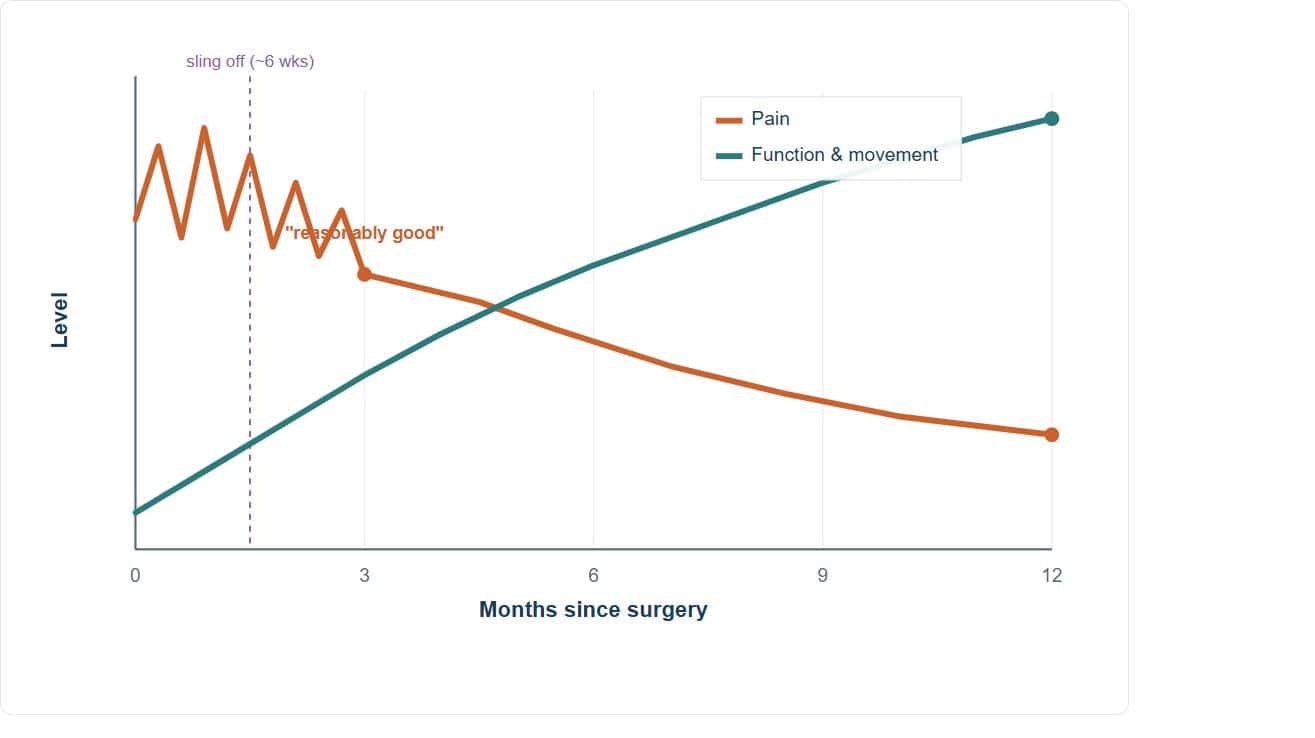
The first three months are the hardest part, and also the most misleading. During this window, pain is genuinely unpredictable — a good few days followed by a setback after a night of poor sleep, an ambitious reach, or no obvious reason at all. This isn’t a sign that anything has gone wrong with the repair. It reflects the biology described earlier: the tendon is slowly re-anchoring to bone, and nerves that have been sensitised by months or years of preceding pain take time to recalibrate. It’s genuinely common to feel like you’re going backwards in week 7 or 8 after feeling encouraged in week 4 — that pattern is expected, not a red flag.
By around three months, most patients reach a point that could fairly be described as “reasonably good” — meaningfully better than before surgery, with sleep improving and day-to-day tasks becoming easier. But this is a milestone, not the finish line. Strength and the last increments of movement continue to improve gradually for a further nine months. Most patients only reach the full extent of their likely improvement at around the twelve-month mark.
It’s also honest to say that outcomes vary. Some patients will still have a degree of shoulder discomfort even at a year, and some will be much improved in function without complete pain relief. This isn’t a failure of surgery — a rotator cuff tear is a complex problem, closely tied to the natural aging process and involving nerve pathways that don’t always fully reset. Pain-relieving medication, and sometimes injections, can help support you through the slower middle stretch of recovery.
Risks Worth Knowing
All surgery carries some risk, particularly related to the heart and lungs under anaesthetic, and this risk is higher for anyone with existing medical conditions such as angina, high blood pressure, asthma, airways disease, diabetes, or significant overweight — these are worth discussing openly before surgery. Locally, some patients notice slight numbness around the wounds, which usually fades over time. Rarely, particularly in soft bone, the anchoring screws can pull loose from the bone, in which case they would need to be removed.
It’s also important to be realistic about the tendon itself: even with a technically well-performed repair, the retear rate can be as high as 40%. Reassuringly, even patients whose repair retears often still end up with less pain and better function than before surgery — the operation isn’t “all or nothing.”
When a Full Repair Isn’t Possible
In some longstanding, badly torn cuffs, the associated muscle has wasted away too much for a repair to hold or succeed. In carefully selected cases, a fluid-filled plastic balloon spacer can be placed in the joint to cushion movement and improve comfort and function without repairing the tendon itself — a biodegradable version of this technology has been formally reviewed in the UK by NICE. Where the joint has also become arthritic, a shoulder replacement may be the more appropriate option, and in carefully selected younger patients, tendon transfer surgery is another option for an irreparable tear.
The Bottom Line
Around 80% of patients are satisfied with their outcome after rotator cuff repair — meaningful pain relief and a return to most everyday activities. But getting there takes patience: expect the tendon to need roughly three months to settle into “reasonably good,” and a full year to reach its best result, with a genuinely bumpy few months of fluctuating pain along the way. Understanding that pattern in advance is one of the most useful things you can do to get through it well.
This article is intended as general patient information and does not replace individual medical advice. Please discuss your own scan findings, surgical plan, and recovery expectations with your surgeon.
Sources: American Academy of Orthopaedic Surgeons, OrthoInfo — patient guide. NICE — HealthTech guidance HTG702, Biodegradable subacromial spacer insertion for rotator cuff tears (2023). NICE — Superior capsular augmentation for massive rotator cuff tears.